Date
12 February 2026 (Thu)
Time
6:30-8:00pm
Location
OEM 602 (Room 602, Oen Hall Building (Main), HSH Campus, HKBU)
Speaker
Fr. Adrian Patrick McCaffery, OP
Language
English
Seminar and Colloquium/ Centre for Sino-Christian Studies
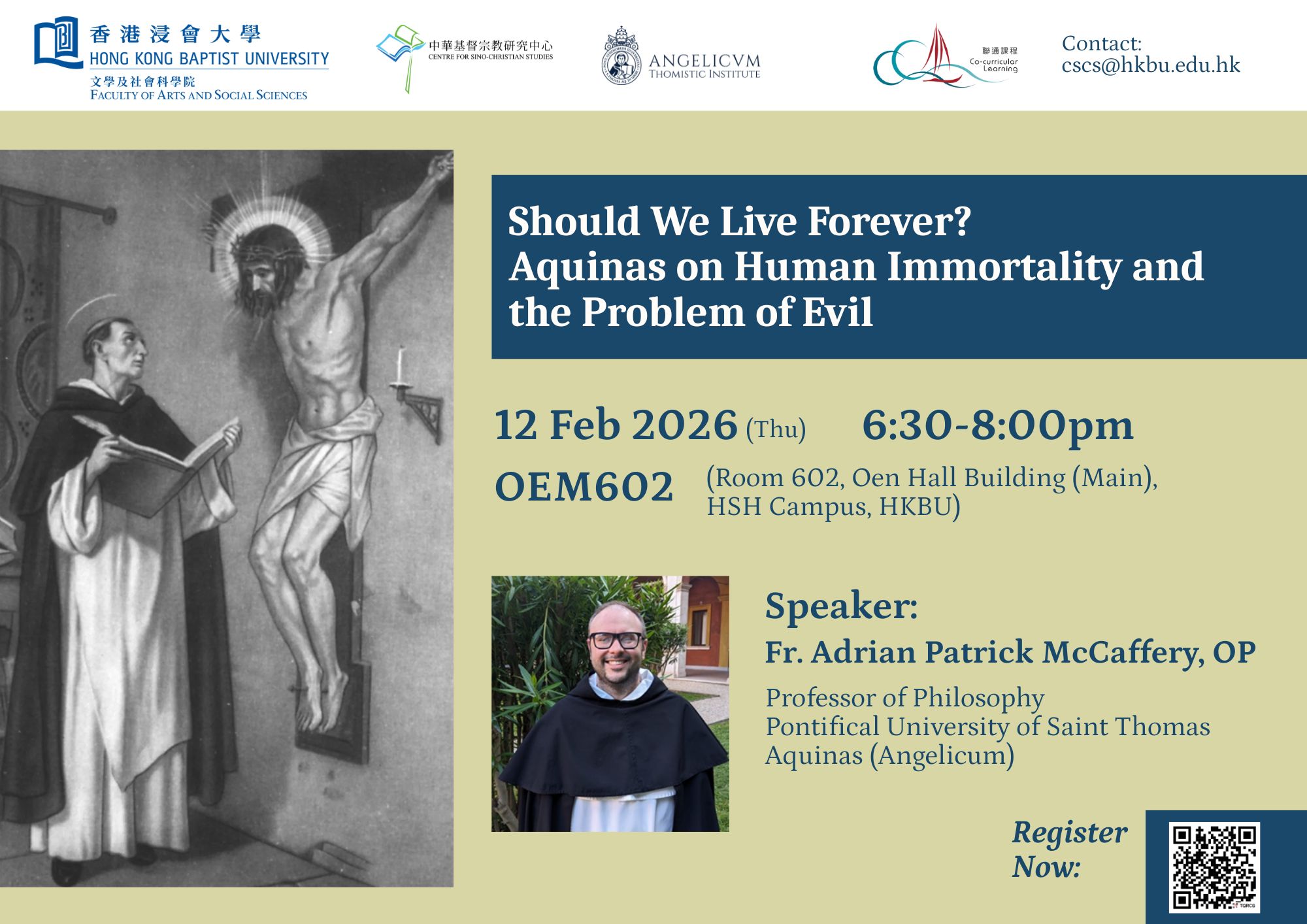
*[5 Feb 2026, 12:00pm] Please note that due to limited seating, formal registration is now CLOSED. Entry will be granted on a first-come, first-served basis. To ensure you secure a seat, we kindly advise arriving early.
Date: 12 February, 2026 (Thursday)
Time: 6:30 - 8:00 PM
Venue: OEM 602 (Room 602, Oen Hall Building (Main), HSH Campus, HKBU)
Speaker: Fr Adrian Patrick McCaffery, OP
Language: English
The problem of evil is often aimed at death, whether premature or unnatural death, yet this talk changes direction to ask if the true evil would be immortality. By applying a Thomistic framework to the nature of the human person, I explore why the soul’s hunger for personal immortality (or perpetual being) is a fundamental good, while a permanent earthly existence might be a nightmare. This overview of the problem of evil from the angle of immortality allows for a distinction between the perfection of a final end and an ongoing, stagnant life that never concludes. By re-evaluating the “badness” of death through this lens, I examine whether the un-realization of an end constitutes a greater privation of the good than human death itself. Ultimately, I argue that while for St Thomas Aquinas immortality is the soul’s natural desire, death serves as the necessary resolution that prevents human existence from becoming a permanent exile from its natural end.
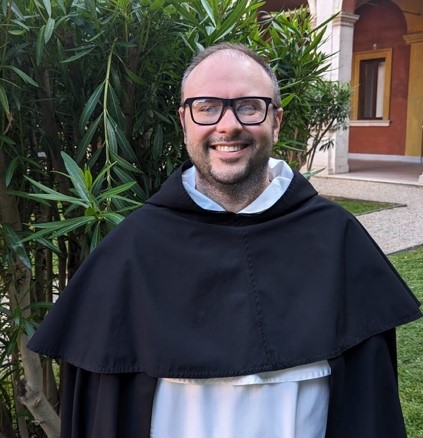
Fr Adrian Patrick McCaffery, OP
Professor of Philosophy, Pontifical University of Saint Thomas Aquinas (Angelicum)
Fr. Adrian Patrick McCaffery, OP, is a friar of the Province of St. Albert the Great. He completed his doctorate in Philosophy in 2024 under Eleonore Stump at Saint Louis University, focusing on the metaphysics of God and Aquinas’s doctrine of divine simplicity. At present, he is a Professor of Philosophy at the Pontifical University of Saint Thomas Aquinas (Angelicum) in Rome, where he teaches metaphysics, philosophical anthropology, aesthetics, and the classical languages. His research primarily engages Aquinas’s philosophical theology in dialogue with analytic philosophy, and he is also overseeing the collection of Fr. Lawrence Dewan’s complete essays for a multivolume set. In addition, he serves as an editor for the Angelicum journal.